Designing Effective KDP Interior Daily Weekly Notes for Diverse Planning Needs
The landscape of self-published low-content books has evolved significantly, moving beyond simple lined paper to sophisticated tools that serve specific cognitive and organizational functions. At the center of this evolution is the KDP Interior Daily Weekly Notes format, a versatile layout that bridges the gap between structured scheduling and freeform ideation. For creators, educators, and professionals utilizing Amazon’s print-on-demand platform, understanding the technical and practical nuances of these interiors is essential for producing high-value resources. This analysis explores the intersection of design specifications, user psychology, and file management required to create superior planning tools.
Technical Specifications and File Integrity
Before addressing the aesthetic or functional aspects of a planner, one must master the foundational technical requirements. The industry standard for these notebooks is the Size 8.5 x 11 No Bleed configuration. This dimension mirrors standard US letter paper, making it compatible with home printers for testing and familiar to users in academic and corporate settings. The "no bleed" designation is particularly critical for note-heavy interiors. Unlike image-heavy art books where graphics extend to the page edge, planners require substantial margins to ensure text remains legible after trimming and binding.
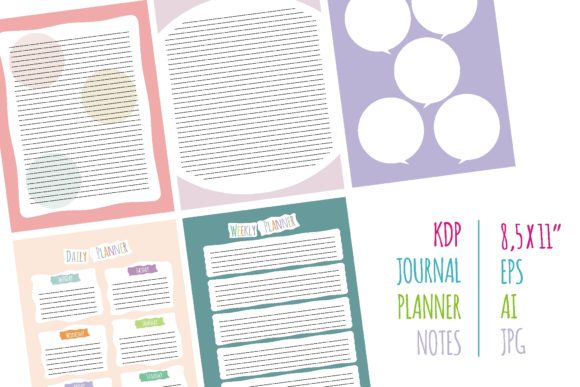
When preparing source files, maintaining a multi-format workflow ensures longevity and editability. Professional designers typically maintain master files in AI (Adobe Illustrator) or EPS formats. These vector-based files allow for infinite scaling and precise adjustment of grid lines, speech bubbles, and typography without pixelation. However, for final upload and proofing, a high-resolution JPG or PDF export is often necessary. While KDP accepts various formats, starting with a vector source guarantees that crisp lines remain sharp at any zoom level during the digital preview process. This technical rigor prevents common rejection issues related to blurry text or misaligned margins.
Margin Safety and Binding Considerations
In an 8.5 x 11 no-bleed interior, the gutter margin is the most vital measurement. For a daily or weekly planner that will be referenced frequently, the binding must not obscure content. A minimum inside margin of 0.75 inches is recommended for page counts exceeding 100 pages, while 0.625 inches may suffice for thinner volumes. Outside margins should never drop below 0.25 inches, though 0.5 inches provides a more comfortable writing experience. Adhering to these safety zones ensures that the Daily Planner Weekly Planner Notes remain fully functional throughout their lifespan, preventing user frustration caused by text disappearing into the spine.
Cognitive Utility of Hybrid Layouts
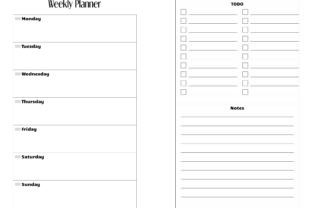
The primary advantage of combining daily and weekly structures lies in cognitive flexibility. Purely daily planners can sometimes induce tunnel vision, where the user focuses on immediate tasks without seeing broader patterns. Conversely, purely weekly spreads can lack the granularity needed for complex project management. A hybrid KDP Interior Daily Weekly Notes system solves this by providing dual perspectives. Users can map out high-level objectives on the weekly spread and then drill down into execution details on the daily pages.
This duality serves distinct audiences differently. Educators may use the weekly view for curriculum pacing and the daily notes for lesson adjustments or student observations. Researchers might track experiment timelines weekly while using daily sections for raw data logging and hypothesis refinement. Business owners often utilize the weekly spread for strategic alignment and daily pages for tactical delegation. By offering both temporal resolutions, the interior supports a wider range of executive functions than single-format alternatives.
The Role of Blank Notes Sections
Structured grids are useful, but unstructured space is where synthesis occurs. Including dedicated Blank Notes areas within both daily and weekly segments is a hallmark of high-quality design. These spaces accommodate non-linear thinking, diagrams, mind maps, and spontaneous ideas that do not fit neatly into hourly slots. From a usability standpoint, blank notes sections increase the perceived value of the book because they transform it from a mere calendar into a comprehensive knowledge management tool. Designers should consider varying the ruling in these sections—dot grid, lined, or completely blank—to cater to different notation preferences.
Visual Communication Through Bubble Speech Elements
An emerging trend in functional planner design is the integration of Bubble Speech graphics. Traditionally associated with comics or children’s activity books, speech bubbles have found a legitimate place in adult productivity tools when used strategically. They serve as visual anchors that break up the monotony of horizontal lines and vertical columns. More importantly, they function as psychological prompts.
- Prompting Reflection: A speech bubble labeled "Key Win" or "Lesson Learned" encourages metacognition more effectively than a plain header.
- Highlighting Priorities: Using a bubble shape for the "Top 3 Tasks" draws the eye immediately to the most critical information upon opening the page.
- Emotional Check-ins: Softer, rounded speech bubbles can designate spaces for mood tracking or gratitude practice, integrating wellness into productivity workflows.
When implementing bubble speech elements in an AI or EPS master file, ensure the stroke weight is consistent with other line work. Overly thick cartoon-style lines can make a professional planner appear juvenile. Opt for clean, minimalist outlines that complement rather than dominate the functional grid. The goal is to enhance usability through visual hierarchy, not to decorate arbitrarily.
Audience-Specific Adaptation Strategies
While the core components of Daily Planner Weekly Planner Notes remain constant, successful KDP interiors are often tailored to specific user segments. Understanding these nuances allows creators to produce books that resonate deeply rather than generically.
For Professionals and Project Managers
This demographic values efficiency and accountability. Interiors designed for them should feature robust weekly overviews with space for project milestones and deadlines. Daily sections benefit from time-blocking grids integrated with open Blank Notes for meeting minutes. Speech bubbles in this context work best as call-out boxes for action items or decision logs. The aesthetic should be clean and corporate-neutral, avoiding excessive ornamentation that distracts from data entry.
For Educators and Students
Academic users operate on semester or term cycles rather than fiscal quarters. Weekly spreads should align with class schedules or study blocks, while daily notes need ample room for lecture capture and assignment tracking. Bubble speech elements can be repurposed as "Question for Instructor" or "Exam Prep" prompts. In this niche, the Size 8.5 x 11 No Bleed format is non-negotiable as it matches textbook dimensions and fits standard backpacks and binders.
For Creatives and Hobbyists
Writers, artists, and makers require flexibility over rigidity. Their ideal KDP Interior Daily Weekly Notes might minimize hourly scheduling in favor of larger blank notes areas and inspirational prompts. Speech bubbles can serve as creative constraints or idea generators. For this audience, the texture and feel of the page matter; ensuring adequate white space prevents the interior from feeling claustrophobic, encouraging free association and brainstorming.
Workflow Optimization for Creators
Producing a high-quality planner requires a disciplined creation workflow. Begin by defining the user persona and their specific pain points before opening any design software. Sketch thumbnail layouts to test the balance between structured and unstructured space. Once the concept is validated, build the master template in AI or EPS to establish global styles for fonts, line weights, and bubble shapes.
After completing the layout, export test pages as JPG files to evaluate visual density on screen. Print physical proofs at actual size to verify margin safety and writing comfort. Pay special attention to how the Bubble Speech elements align across facing pages; asymmetry can be visually jarring in a spread-based layout. Finally, compile the full interior according to KDP specifications, double-checking that the Size 8.5 x 11 No Bleed settings match the uploaded file dimensions exactly. This methodical approach minimizes revision cycles and results in a professional-grade product that meets genuine user needs.
Evaluating Long-Term Usability
The true measure of a planner’s success is sustained use over weeks and months. Designs that look attractive in thumbnails but fail in practice lead to negative reviews and returns. To ensure long-term viability, prioritize function over form. Test the Blank Notes sections with actual pens and markers to confirm adequate spacing. Verify that Daily Planner Weekly Planner Notes transitions feel intuitive rather than disjointed. Consider whether the speech bubble prompts remain relevant after repeated exposure or if they become visual noise.
Ultimately, creating effective KDP interiors is an exercise in empathy. It requires stepping into the shoes of the researcher, teacher, manager, or artist who will rely on this tool daily. By combining precise technical execution with thoughtful user-centered design, creators can develop KDP Interior Daily Weekly Notes that transcend commodity status to become indispensable companions in their users' productive lives. The availability of editable source files in AI, EPS, and JPG formats further empowers this iterative improvement process, allowing designs to evolve alongside user feedback and changing needs.