Weekly Time Sheet Book KDP Interior: A Technical Guide to 6x9 No-Bleed Publishing
The landscape of low-content publishing on Amazon has shifted from simple repetition to functional utility. For creators targeting professionals, contractors, and small business owners, the Weekly Time Sheet Book KDP Interior represents a high-demand niche that bridges the gap between digital tracking and physical record-keeping. Success in this category relies less on artistic flair and more on technical precision, usability testing, and adherence to strict printing specifications. Understanding the architecture of a 120-page, 6x9 no-bleed interior is essential for producing a product that meets professional standards and passes Amazon’s automated quality checks without delay.
Functional Design Variants for Diverse User Needs
A common misconception in low-content publishing is that a single layout satisfies all users. However, time tracking needs vary significantly across industries. A comprehensive Weekly Time Sheet Book KDP Interior package should include multiple distinct variants to capture a broader market segment. Providing four different PDF options allows publishers to target specific demographics or create a series of related products under a single brand umbrella.
Standard Hourly Tracking Layout
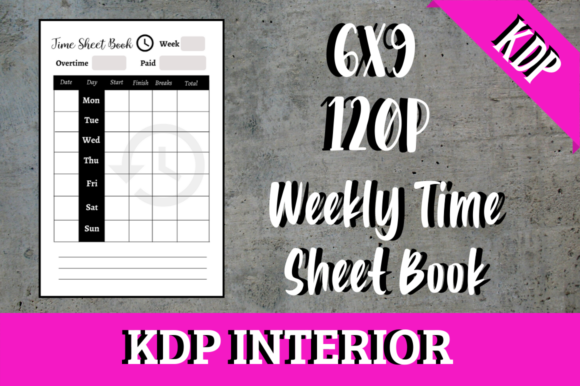
The most universal variant focuses on simplicity. This layout typically features columns for Date, In-Time, Out-Time, Break Duration, Total Hours, and a brief Task Description. It is designed for general employees, students, or hobbyists who need to log activity without complex categorization. The spacing must be generous enough for handwriting but compact enough to fit a full week on a single page or spread. In a 6x9 format, this often requires precise margin management to ensure the writing area remains accessible after binding.
Project-Based and Job Costing Variant
Contractors, freelancers, and tradespeople require more than just hours; they need to associate time with specific jobs or clients. This variant replaces generic task descriptions with dedicated fields for Project Name, Client Code, and Billable vs. Non-Billable status. This design transforms a simple logbook into a preliminary invoicing tool. When designing this interior, consider adding a weekly summary section at the bottom of the page where users can tally hours per project, facilitating easier data transfer to accounting software at the end of the month.
Overtime and Compliance-Focused Template
For industries with strict labor regulations, such as healthcare, security, or transportation, tracking regular hours is insufficient. A compliance-oriented variant includes pre-calculated sections for Regular Time, Overtime (1.5x), Double Time, and Sick Leave. This layout serves as a physical audit trail. Publishers creating this version must ensure column headers are unambiguous and that there is adequate space for supervisor signatures or initials, which are often required for payroll validation. This specific utility elevates the book from a notebook to a business compliance asset.
Minimalist Productivity and Habit Tracker Hybrid
Not all time tracking is for payroll. Researchers, writers, and self-improvement enthusiasts often track time to analyze productivity patterns rather than bill clients. This variant blends time logging with qualitative metrics, such as energy levels, focus ratings, or daily goals. The design aesthetic here shifts from tabular rigidity to open-ended flexibility. While still adhering to the 6x9 no-bleed constraints, this layout uses whitespace strategically to encourage reflection alongside data entry, appealing to the personal development segment of the KDP market.
Technical Specifications: Mastering the 6x9 No-Bleed Format
The physical constraints of the Weekly Time Sheet Book KDP Interior dictate its usability. The 6x9 inch trim size is the industry standard for portable logbooks, offering a balance between writing surface area and pocketability. However, the "no bleed" specification introduces critical design parameters that must be respected to avoid rejection during the upload process.
Understanding Safe Zones and Margins
In a no-bleed configuration, all content must remain within the safe zone, maintaining a minimum buffer from the trim edge. For a 6x9 book, Amazon KDP generally requires a minimum inside margin (gutter) that scales with page count. With 120 pages, the gutter should be at least 0.375 inches, though experienced publishers often increase this to 0.5 or 0.6 inches to account for the curvature of the binding. If text or table lines extend into the gutter, the book becomes difficult to use, rendering it functionally obsolete regardless of how good the digital preview looks.
Line Weight and Print Clarity
KDP uses print-on-demand technology that can sometimes render very thin lines inconsistently. For time sheet interiors, where grid lines define the usability of the page, line weight matters. Tables and dividers should generally be set between 0.5pt and 0.75pt. Lines thinner than 0.25pt may disappear or appear broken in print, while lines thicker than 1pt can look clunky and reduce the perceived professionalism of the document. Testing these weights across different devices and, ideally, ordering a physical proof copy is a non-negotiable step in the quality assurance workflow.
Pagination and Binding Alignment
A 120-page count is significant for a 6x9 logbook. It provides approximately six months of weekly tracking if using one page per week, or three months if using two-page spreads. Publishers must decide early whether the interior will be single-sided or double-sided. Single-sided printing prevents ink bleed-through from markers or gel pens, a common complaint in low-content reviews. However, it doubles the page consumption. If utilizing both sides, ensure that mirror margins are correctly applied so that the gutter alternates appropriately between left and right pages. Misaligned gutters are a frequent cause of negative user experiences in bound notebooks.
Workflow Integration: From PDF Creation to KDP Upload
Having four formatted and tested PDF files streamlines the publishing pipeline, but integration requires attention to metadata and file naming conventions. Each variant of the Weekly Time Sheet Book KDP Interior should be treated as a distinct SKU or bundled strategically. When preparing files for upload, ensure the PDF is flattened and optimized for print. Interactive elements, layers, or RGB color profiles must be converted to CMYK or grayscale depending on the selected ink option. Since time sheets are primarily functional documents, black and white interior printing is usually the most cost-effective choice, allowing for a lower price point and higher royalty margin.
Quality Assurance Protocols
Before uploading any of the four variants, run them through rigorous pre-flight checks. Verify that the document dimensions match exactly 6x9 inches. Confirm that the total page count matches the metadata entered in the KDP dashboard; a mismatch here will trigger an immediate error. Use the KDP Previewer tool to inspect every tenth page specifically for alignment drift. Digital screens can mask issues that become glaringly obvious in physical form. Because this product is marketed as "ready for printing," the burden of quality rests entirely on the creator. A single misaligned table can result in returns and damage to the publisher's reputation.
Market Relevance and Practical Application
The enduring demand for physical time sheets stems from reliability and legal necessity. Digital apps fail when batteries die, signals are lost, or software subscriptions lapse. A physical book provides an immutable record that does not require updates or internet access. For educators teaching vocational skills, these books serve as training tools for future workforce habits. For researchers conducting field studies, they offer a distraction-free method of temporal data collection. For small business owners, they provide a tangible backup to digital payroll systems.
Furthermore, the tactile nature of writing down time entries reinforces mindfulness regarding work habits. In an era of digital fatigue, many professionals seek analog alternatives for routine administrative tasks. By providing a well-structured, professionally formatted interior, publishers enable this transition. The value proposition is not merely paper and ink; it is organized peace of mind. The four variants address the reality that "time tracking" is not a monolith. A nurse, a carpenter, a freelance graphic designer, and a doctoral candidate all track time, but they do so with fundamentally different cognitive and regulatory frameworks. Recognizing and catering to these differences through specialized interior design is what separates successful KDP businesses from saturated commodity sellers.
Optimizing for Long-Term Viability
Sustainability in low-content publishing comes from evergreen utility. Trends fade, but the need to record labor and manage projects persists. When developing a Weekly Time Sheet Book KDP Interior, avoid dating the pages unless absolutely necessary. Undated interiors have an infinite shelf life and reduce the risk of unsold inventory becoming obsolete at year-end. If dated versions are preferred for specific niches, consider creating undated master templates that can be quickly modified for future years, leveraging the initial design investment over multiple publishing cycles.
Additionally, consider the cover design's relationship to the interior. A professional, minimalist cover signals that the contents are equally professional. The exterior should reflect the specific variant inside; a construction-themed cover should not house a minimalist productivity layout. Cohesion between the external marketing and internal functionality builds trust with the buyer. Ultimately, the goal is to create a resource that users rely upon daily. When a product becomes part of a professional's workflow, it generates organic word-of-mouth promotion and repeat purchases, establishing a stable foundation for a low-content business portfolio.